
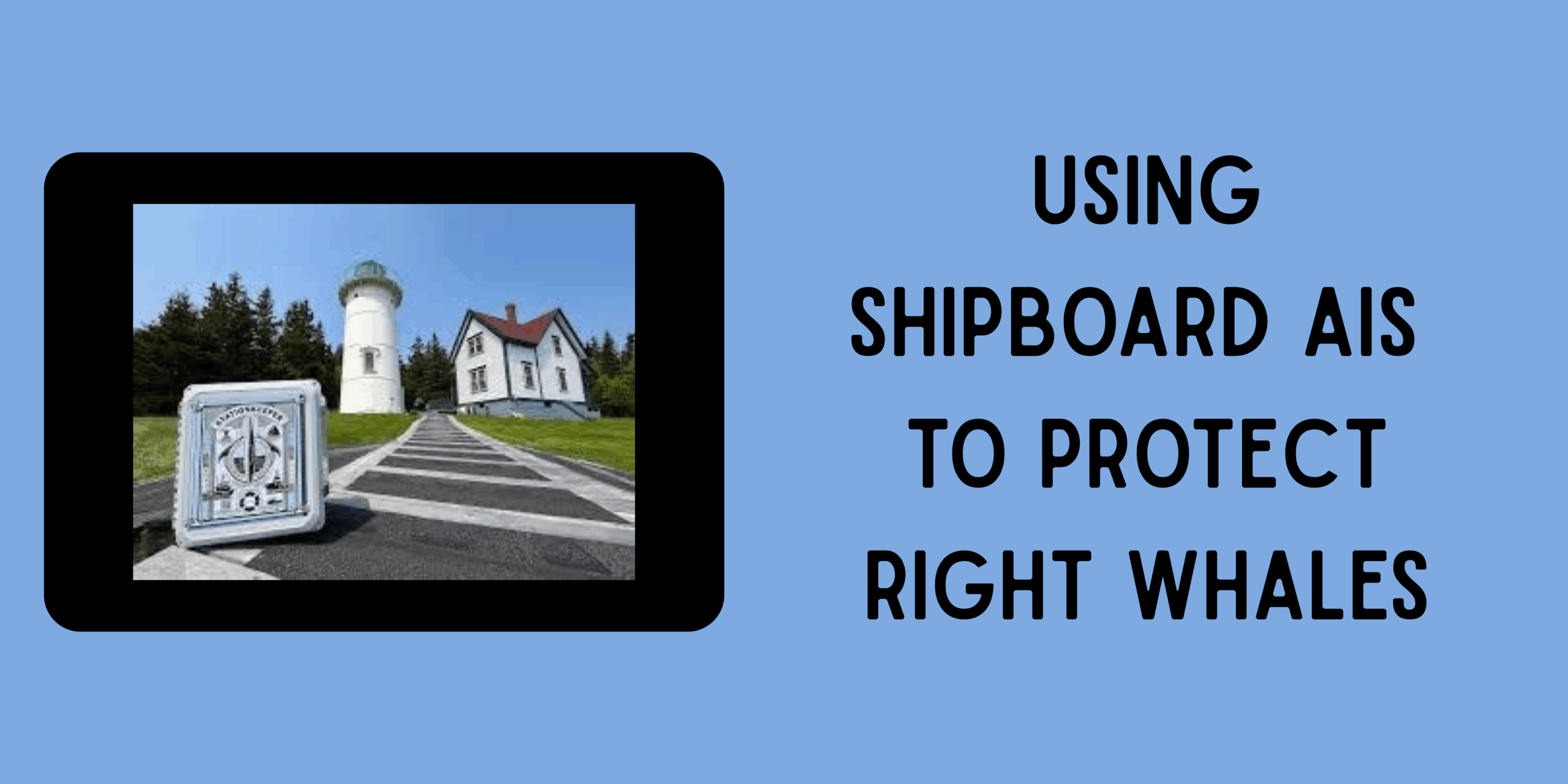

Scott and Phyllis Rowley traveled to New England this summer to investigate the history of whale oil used in our Amelia Island lighthouse.
During a visit to the Woods Island Lighthouse in Maine and Sapelo Island Lighthouse in Georgia, Scott discovered AIS StationKeepers installed in their lighthouse towers. He was able to share some of the very recent progress of these installations in East Coast lighthouses, and how they could help our right whales.

An AIS StationKeeper installed in a lighthouse broadcasts to ships when they enter a seasonal management area when whales congregate.
Podcast about Lighthouses, StationKeepers, and Right Whales
On their trip, Phyllis discovered the following podcast with an exciting conversation about Lighthouses, StationKeepers and Right Whales.
Right whales cannot be tagged and “see and avoid” is the only protection these marine mammals have from collisions with ocean-going vessels. To decrease the risks of vessel strikes, NOAA established seasonal management areas (SMAs) around regions the whales congregate, restricting the speed of the larger vessels transiting through the area.
All large vessels are required by law to carry and use Automated Identification System (AIS) radios while within the waters of the United States. The AIS automatically broadcasts information about the vessel such as its name, identification number, size, speed, and direction of travel. These broadcasts can be displayed on the electronic charts of other vessels, thereby reducing the risks of vessel collisions. AIS also has the capability of displaying messages sent to an individual vessel.
MotionInfo has developed the technology of receiving the AIS broadcasts and determining the vessel size, speed, and direction of travel relative to any SMA. This technology can then be used to transmit a message to the vessel that it is entering a SMA and if the vessel is exceeding the speed limit. The electronics to detect and transmit to the vessels is packaged in a small waterproof unit called StationKeeper. This is real-time and location-specific communication to the vessel. The expectation is that, once notified, the vessel will lower its speed.
AIS systems use marine VHF radio frequencies. The range of VHF radios is what is known as “line-of-site,” with higher antennas being able to “see” further. Obviously, monitoring vessels over the entire range traveled by right whales requires numerous transmitters spaced along the coast. MotionInfo is working with many lighthouses to place these StationKeeper units in the towers using the advantages of being close to the shore, at higher elevations, without obstructions, and with electricity and WiFi needed to operate the units.
This podcast by the Lighthouse Society is a discussion with the creators of this technology and the placement of their StationKeeper units in various lighthouses along the coasts of the United States. Click here to listen to the podcast.

Bob Trapani, Jr., American Lighthouse Foundation Executive Director, working on installing MotionInfo’s AIS StationKeeper inside the lantern of Little River Light in Maine. (Photo by Ann-Marie Trapani)
Local Area StationKeeper Installations
StationKeeper locations close to Amelia Island include units placed at Seaside Amelia Inn, Sapelo Island light house, and the News4JAX broadcast tower in Jacksonville. The SMA covering Amelia Island waters is active during the calving season between November 15 and April 15 of each year.
Join us at Seaside Amelia Inn for a Presentation
Dr. Scott Rowley will be speaking at a presentation and discussion about Lighthouses, StationKeepers, and Right Whales on the Rooftop of the Seaside Amelia Inn on Thursday, October 2, 2025 from 4:00 – 5:00pm. Come a bit early to check out the view and our local StationKeeper Installation!
The Seaside Amelia Inn is located at 2900 Atlantic Ave, Fernandina Beach, FL 32034.
