
Written by Dr. Scott Rowley
If a bill in Congress passes, it will remove protections for North Atlantic right whales. More specifically, for the next 9 years it will prevent any new regulations intended to protect our whales from “incidental take” connected to commercial fishing.
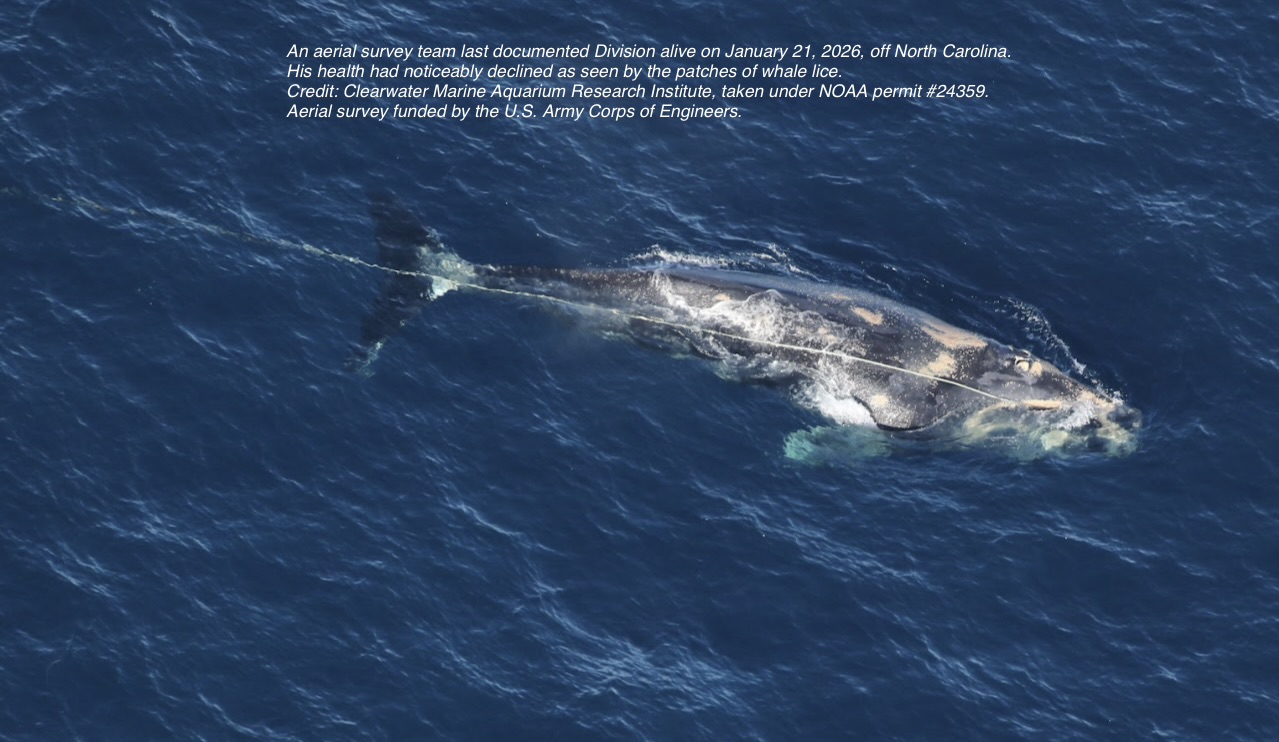
There are fewer than 400 North Atlantic right whales in existence. In the summer, they eat tiny zooplankton in the waters off New England and Canada. In the winter, the pregnant whales swim to the waters off Amelia Island to give birth. Along the way, they have to avoid about one million lobster trap lines. 85% of these whales have been entangled at least once, often multiple times. Buoy line entanglements are the leading cause of death for these whales.
The Marine Mammal Protection Act (MMPA) enacted in 1972 requires the protection of all marine mammals from any incidental “take” (e.g., death, serious injury) from human activities such as commercial fishing. Numerous regulations developed under the MMPA since 1972 address specific species, human activities, or ocean regions. For example, regulations to protect dolphins “taken” during tuna fishing successfully reduced the dolphin death rate (e.g., “dolphin-safe” tuna).
In 1997, National Marine Fisheries Service (NMFS) and National Oceanic and Atmospheric Administration (NOAA) instituted the Atlantic Large Whale Take Reduction Plan. These regulations addressed use of gillnets, marking of gear in some regions of the Northeast, and seasonal fishing restrictions in certain whale habitats when large whales were more likely to be present. The plan is intended to evolve as we learn more about why whales become entangled and how fishing practices might be modified to reduce the risk of entanglement.
In 2021 in response to a major increase in whale deaths occurring over the previous several years, amendments to the Atlantic Large Whale Take Reduction Plan were enacted. These regulations included:
- Changing fishing techniques in use by commercial fishermen to reduce the number of buoy lines,
- Promoting development of “on demand” traps that do not require a floating buoy,
- Adjusting restricted areas in which whales congregated and fishing would not be allowed,
- Requiring gear marking in all New England waters to identify areas in which right whales become entangled.
These new regulations, and similar regulations instituted by Canada, reduced but did not eliminate the excess deaths occurring from line entrapment.
But, led by representatives from Maine, Congress in 2022 enacted a law that established a moratorium on any new regulations to be enacted before the end of 2028, even if new ideas or techniques to protect the right whale were developed during this period.
Representatives Jared Golden (ME-2) and Mike Lawler (NY-17) are co-sponsoring H.R. 9436, the “Northeast Lobsterman Protection Act”, which would extend this moratorium on new regulations an additional seven years from 2028 to 2035. This moratorium would preclude regulatory adoption of the new techniques that are being developed by many businesses involved in fishing and other maritime activities. H.R. 9436 gives no rationale to justify the extension of the moratorium, nor why the 2035 date is specified. This amendment is in clear conflict with the requirement of the Marine Mammal Protection Act that the right whale and other marine mammals be protected from harm or death by human activities.
The North Atlantic right whale is critically close to extinction. Modernizing fishing techniques will greatly reduce the risk to the right whales and should be encouraged, not outlawed. We ask that you contact Representative Bean and Senators Scott and Moody asking that they vote no on HR 9436.
Save our right whales…before they go extinct.
Contact your representatives
To contact Representative Bean: https://bean.house.gov/address_authentication?form=/contact
To contact Senator Moody: https://www.moody.senate.gov/contact-us/
To contact Senator Scott: https://www.rickscott.senate.gov/contact/share-your-opinion

Gear removed from North Atlantic right whale “Division” (#5217) laid out at NOAA Fisheries’ Greater Atlantic Regional Fisheries Office in Gloucester, Massachusetts, on January 14, 2026. Credit: Fisheries and Oceans Canada/Ed Trippel.