
Written by Robin Pullen
FERNANDINA BEACH — For a sold-out audience Monday evening, the story of the North Atlantic right whale was more than a nature documentary. It was a call to protect one of the rarest large whales on Earth.
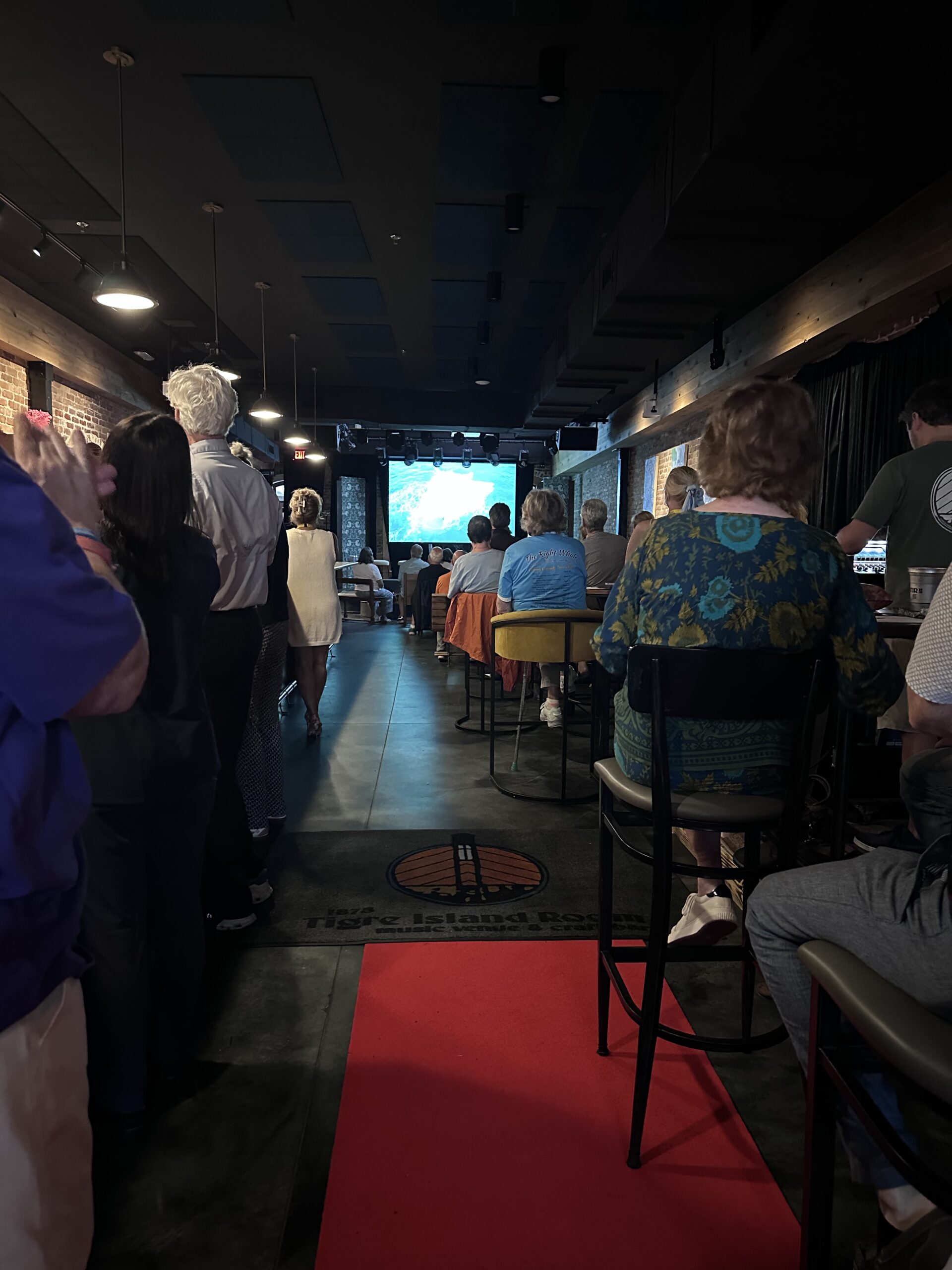
The Amelia Island Whale Ambassadors hosted a screening of the award-winning documentary The Right Whale: Tales of Resilience and Hope on Aug. 24 at the Tigre Island Room in downtown Fernandina Beach. Filmmakers Cheryl and Nick Dean, of Spindrift Images, attended the screening and shared stories from their expeditions, their encounters with whales, and their concerns about the species’ future.
The film travels from southern right whale breeding grounds in remote sub-Antarctic waters to the increasingly perilous habitat of North Atlantic right whales, showing both what conservation can accomplish and how quickly progress can be lost.
For Amelia Island Whale Ambassadors Executive Director Candis Whitney, the evening was also evidence of how deeply the community has embraced the whales.
Whitney said she was “overwhelmed with the support of the right whale community.”
Her own commitment grew after seeing a right whale and recognizing how transformative such an encounter could be. The annual Right Whale Festival brings attention to the animals for two days each year, but Whitney envisions keeping the whales visible to residents and visitors throughout the other 363 days.
That vision helped expand into Amelia Island Whale Ambassadors, whose mission centers on education and awareness.
The need remains urgent. NOAA Fisheries estimates the North Atlantic right whale population at approximately 380 animals, including only about 70 reproductively active females. Although recent numbers have offered cautious signs of improvement, entanglements in fishing gear and collisions with vessels remain leading causes of death and serious injury.
This year’s Southeastern calving season brought encouraging news: researchers identified 23 mother-calf pairs, and nearly 130 individual right whales were sighted in the Southeast. Florida and Georgia coastal waters serve as the species’ primary calving grounds.
The film reminded viewers why those mothers matter.
A calf stays close to its mother, often resting between her pectoral fins (flippers), learning to swim and navigate the ocean beside her. The whales communicate through deep rumbles, calls and other sounds over great distances. They feed by opening their mouths and filtering tiny organisms through their baleen.
They are also remarkably social animals. The film showed mothers and calves interacting, whales appearing to care for one another, and scientists working to better understand an animal whose sensory world is largely hidden beneath the surface.
Historically, right whales earned their unfortunate name because commercial whalers considered them the “right” whales to hunt: they were slow-moving and trusting, often traveling near shore. Centuries of whaling devastated their populations.
Southern right whales have demonstrated that recovery is possible when sustained protection works. That success provides hope for their North Atlantic relatives — but is also a warning about what is at stake.
Local whale advocates told the audience that individual action matters.
Sharla Mandt recalled outreach efforts that began with only a few people and expanded through social media and community involvement. Her message is strong: every person who learns about right whales can do something to help.
Longtime advocate Krissi Barr described witnessing a right whale calf’s birth in 2002, surrounded by dolphins. Experiences such as that convinced her that legislation, education and sustained public involvement can make a difference.
Technology also plays an increasingly important role in conservation. Scientists photograph individual whales and compare their distinctive markings, use acoustic monitoring to listen for their calls and employ tagging and other techniques to better understand where whales are traveling. NOAA is also exploring satellite monitoring and technologies designed to help vessels detect and avoid whales.
But technology cannot eliminate every threat.
Rope entanglement can cause wounds, exhaustion, starvation and death. Vessel strikes can be fatal, particularly because whales can be difficult to see at night or during poor weather.
The documentary and discussion emphasized vessel-speed restrictions and the development of on-demand, sometimes called “ropeless,” fishing gear as important tools for reducing those dangers.
Current federal protections for right whales fall under laws including the Marine Mammal Protection Act and Endangered Species Act. Whale advocates at Monday’s event urged residents to pay attention to congressional and regulatory proposals that could weaken protections or delay implementation of new safeguards.
Their message to the audience was practical: contact U.S. representatives and senators, support science-based protections, remove discarded fishing line from beaches and waterways, report whale sightings appropriately and give whales plenty of space on the water.
The Amelia Island Whale Ambassadors’ goal is achievable: save the right whale before it goes extinct.
That mission is particularly relevant on Amelia Island. Each winter, pregnant North Atlantic right whales make their way to the warmer waters off Florida and Georgia to give birth and nurse their calves. What happens along this coastline can affect the survival of the entire species.
The filmmakers closed on a note of possibility rather than despair — imagining an ocean in which future generations can still encounter these gentle giants.
For the audience at the Tigre Island Room, that possibility came with a challenge.
Learning about the whales is only the beginning.
Protecting them requires people willing to act.
The Aug. 24 screening was presented by Amelia Island Whale Ambassadors with support from Defenders of Wildlife. The documentary was produced and directed by Cheryl and Nick Dean of Spindrift Images. Article presented by Robin Pullen.


Leave a Reply