
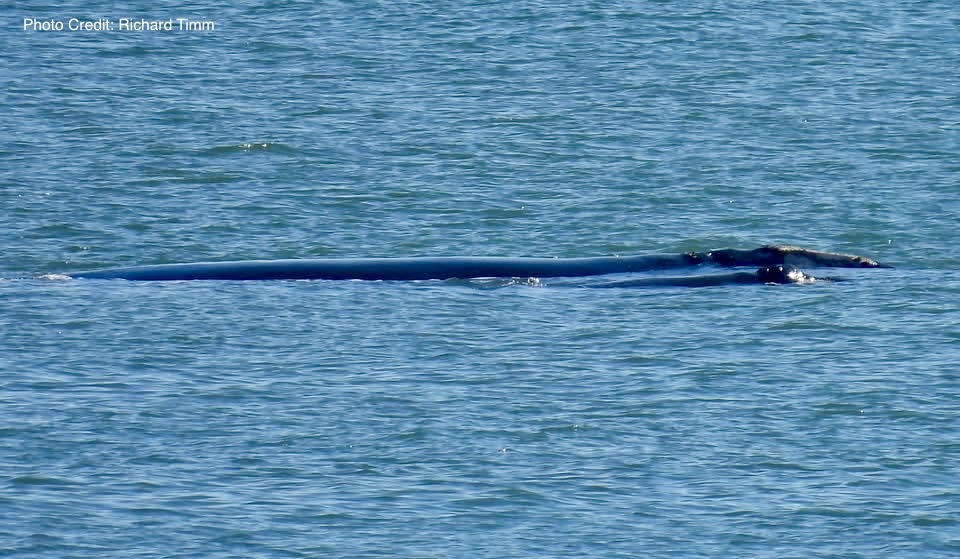
#1: Champagne

On November 28, 2025, the first mother calf pair spotted for the 2025-26 North Atlantic Right Whale Calving Season was Champagne and her calf in the waters 7 miles off Ocean Isles Beach, North Carolina!
Get to Know Champagne!
Champagne was born in 2009 and is 17 years old. This is her second documented calf, with her last calf born in 2021! Now that’s a reason to pop some champagne and celebrate!
How did Champagne get her name?
Champagne’s callosity pattern looks like the bubbles in champagne! Let’s toast to Champagne having the first calf of the season!
#2: Millipede (Catalog #3520)

On December 3, 2025, the Florida Fish and Wildlife Conservation Commission aerial survey team spotted Millipede with a calf east of the Florida/Georgia border about 5 miles east of the St. Mary’s River entrance! This was the second mother/calf pair to be spotted this calving season.
Get to Know Millipede!
Millipede is 21 years old, and this is her third documented calf. She has also survived four entanglements.
Millipede and her calf also made an appearance near the shore of Amelia Island on December 12, delighting everyone who was able to catch of glimpse of the pair!
How did Millipede get her name?
Millipede’s name comes from the shallow propeller scars on her right side that look like the many segments of a millipede.
#3: Callosity Back (Catalog #3760)

On December 4, 2025, the Clearwater Marine Aquarium Research Institute aerial survey team spotted Callosity Back and her calf east of Debidue Beach, SC! This was the third mother/calf pair to be spotted this season.
Get to Know Callosity Back!
Callosity Back is 18 year old, and this is her first documented calf. Hooray for a first time mother!
How did Callosity Back get her name?
Her name comes from the callosity on her back… she is the only right whale known to have callosities in this spot… they are usually only found on the head!
#4: Bocce (Catalog #3860 )

On December 10, 2025, 8 miles off Doboy Sound, Georgia, the Clearwater Marine Aquarium Research Institute’s aerial survey team spotted Bocce and her new calf!
Get to Know Bocce!
This is Bocce’s third known calf. She previously had calves in 2016 and 2021. Her 2016 calf presumably died shortly after birth, but she helped nurse two other calves that year! Her 2021 calf (#5160) is a female and was seen as recently as the fall.
How did Bocce get her name?
Bocce was named after the popular lawn game, which her callosities resemble!
#5: Squilla (Catalog #3720)

On December 11, 2025, about 10 miles east of Sullivans Island Lighthouse, South Carolina, the Clearwater Marine Aquarium Research Institute’s aerial survey team spotted Squilla and her calf!
Get to Know Squilla!
Squilla is 19 years old and this is her second known calf. Her last calf was born in 2021. When that calf was one year old, it became entangled in fishing gear, and died in January 2024.
How did Squilla get her name?
Squilla’s mother is Mantis… and Squilla’s callosity patterns look like the eyes of a Squilla mantis shrimp!
#6: Cascade (Catalog #3157)

On December 16, 2025, about 21 miles east of Ossabaw Island, Georgia, the Clearwater Marine Aquarium Research Institute’s aerial survey team spotted Cascade and her new calf. The calf was less than 4 days old, as the team had seen Cascade without a calf on December 12!
Get to Know Cascade!
Cascade is 25 years old and she this is her fourth known calf. “FDR” was her first calf, a male, and was seen in 2016 with a severe entanglement and is presumed dead. The other two, also males, were seen within the last year.
How did Cascade get her name?
Cascade was named for the lesions/scars cascading down the sides of her lips and lower jaw.
#7: Harmonia (Catalog #3157)

On December 17, 2025, about 11 miles east of St. Simons Island, Georgia, a Georgia Department of Natural Resources vessel survey team spotted Harmonia and her new calf.
Get to Know Harmonia!
Harmonia is 25 years old and this is her fourth calf. Her first calf died at a year old from a vessel strike. Her second calf was last seen in 2021, and her third calf was seen within the last year. She had her last calf in 2020.
How did Harmonia get her name?
Harmonia’s mother is named Aphrodite (#1701), and Harmonia is one of the daughters of the Greek goddess with the same name.
#8: Tripelago (Catalog #2614)

On December 20, 2025, about 38 miles east of Ossabaw Island, Georgia, the Clearwater Marine Aquarium Research Institute’s aerial survey team spotted Tripelago and her calf.
Get to Know Tripelago!
Tripelago is 30 years old and this is her sixth known calf. She has had 4 male calves before and one female. Her last calf was born in 2022.
How did Tripelago get her name?
She is named after the callosities on her head shaped like three islands. The name is a play on words for archipelago.
#9: Echo (Catalog #2642)

On December 21, 2025, about 22 miles east of Little Saint Simons Island, Georgia, the Clearwater Marine Aquarium Researdh Institute’s aerial survey team spotted Echo and her new calf!
Get to Know Echo!
Echo is 30 years old and this is her fourth known calf. All three of her previous calves have been seen within the year. She had her last calf in 2020. Her daughter, Quill, was born in 2010 and is old enough to have a calf, but has not made Echo a grandmother yet!
Echo has a white chin, which is not common for North Atlantic right whales…and guess what! This year’s calf has a white chin too!
How did Echo get her name?
Echo’s single island circular callosity on her head resembles the letter “E” in Morse code… and in the NATO phonetic alphabet, you say “E” as “echo”.
#10: Bermuda (Catalog #3780)

On December 23, 2025, about 12 miles east of the St. Mary’s River entrance in Florida, the Florida Fish and Wildlife Conservation Commission aerial survey team spotted Bermuda and her new calf!
Get to Know Bermuda!
Bermuda is at least 19 years old. This is Bermuda’s second known calf… her first calf was born in 2024, but shortly after birth, she was observed without her calf. A typical time between calves is 3-4 years. Seeing a two year interval has previously only been seen when a calf has died early, while still in the calving grounds.
How did Bermuda get her name?
There are three islands of callosity on Bermuda’s head in the shape of a triangle… to make it even more interesting, sometimes one of her callosities disappears! What better to name her after than the mysterious Bermuda Triangle! Bermuda was just name in 2025!
#11: Uca (Catalog #3390)

On December 23, 2025, about 15 miles east of Hilton Head Island, South Carolina, the Clearwater Marine Aquarium Research Institute’s aerial survey team spotted Uca and her calf!
Get to Know Uca!
Uca is at least 23 years old. This is her second known calf, with her first being born in 2012. That calf was a female, but is presumed dead, as it has not been seen since 2015. It’s been awhile since she’s had a calf, but in that time, she has been entangled at least five times.
How did Uca get her name?
You know how a fiddler crab has one claw that is way bigger than the other one? Well, Uca’s right side callosity is bigger than her left side… making it look lopsided, like a fiddler crab. Uca is the Latin name for the fiddler crab!
#12: Mantis (Catalog #1620 )

On December 26, 2025, about 18 miles east of Kiawah Island, South Carolina, the Clearwater Marine Aquarium Research Institute’s aerial survey team spotted Mantis and her new calf!
Get to Know Mantis!
Mantis is at least 40 years old! This is her eighth known calf, with the last one being born in 2022. A couple of notable things… Did you notice the name of Mother #5’s mother in the “How did she get her name” section? YES! Mantis is Squilla’s mother! So she has a new baby AND a new grandbaby! Mantis is also one of three mothers who gave birth to babies this year, and also gave birth in 2022!
How did Mantis get her name?
Well, if you read #5, you might have a clue already! Mantis’ callosity pattern resembles a mantis shrimp!
#13: Juno (Catalog #1612)

On December 27, 2025, about 9 miles east of Wassaw Island, Georgia, the Clearwater Marine Aquarium Research Institute aerial survey team spotted Juno and her calf!
Get to Know Juno!
Juno is at least 40 years old. This is her ninth known calf. You might remember following her story a couple years ago. (Click here to see the full story.) Juno had the first calf of the season in the 2023-2024 season, but it suffered injuries to its head due to a vessel strike. We followed the story of Juno and her calf, hoping it would recover, but it died before leaving the calving grounds. As mentioned in #10 above, a two year span between calves typically only occurs if a calf passes away shortly after birth. Juno’s journey through motherhood has been challenging. Five of her previous eight calves have been confirmed or presumed dead.
How did Juno get her name?
Juno was named after the Roman goddess Juno. Juno’s convex rostrum is a feature known as a “Roman nose”.
#14: Binary (Catalog #3010)

On December 27, 2025, about 7 miles east of Blackbeard Island, Georgia, the Clearwater Marine Aquarium Research Institute aerial survey team spotted Binary and her calf!
Get to Know Binary!
Binary is at least 26 years old. This is her fourth known calf. Binary’s last calf was born in 2021. There are four other mothers who also gave birth in 2021! Her calf that was born in 2021 was male Catalog #5110, and he was seen entangled in April 2025.
How did Binary get her name?
Binary has a portion of callosities on her head that look like a binary star system. A binary star system is a pair of two stars that orbit around each other.
#15: Boomerang (Catalog #2503)

On January 1, 2026, about 9 miles east of the St Mary’s River entrance on Florida/Georgia border, the Clearwater Marine Aquarium Research Institute’s aerial survey team spotted Boomerang with her calf! Happy New Year! Boomerang was seen on December 20 without a calf, so her calf was less than two weeks old when they spotted them!
Get to Know Boomerang!
Boomerang is 31 years old. This is her fifth known calf. Boomerang had her first calf in 2006 (“Lone Star” #3620, named for their trek to Texas) and she brought that calf to the Gulf waters, all the way to Corpus Christi! She is one of the few right whales to be documented in the Gulf. That calf has not been seen since 2016 and is presumed dead. The only female calf that she has had was born in 2009 (“Frisbee” #3980) and is old enough to have a calf, but has not made Boomerang a grandmother yet. Boomerang’s last calf was born in 2019, a male, #4903 and he has been seen within the last year.
How did Boomerang get her name?
Boomerang has a white scar shaped like a boomerang on the underside of her fluke.
#16: Skittle (Catalog #3260)

On January 5, 2026, about 18 miles east of the St. Mary’s River entrance in Florida, the Florida Fish and Wildlife aerial survey team spotted Skittle and her calf!
Get to Know Skittle!
Skittle is at least 24 years old. This is her third known calf. Skittle was entangled in 2007. A line and a buoy trailed from her mouth. She shed the gear on her own and was confirmed gear free in 2008. Skittle had her first calf in 2010 and her second in 2024. Both calves likely died shortly after they were born.
How did Skittle get her name?
Skittle is named for her callosity pattern that resembles the bowling pin used in the traditional British sport of skittles.
#17: (Catalog #3593)

On January 6, 2026, about 15 miles east of Jacksonville Beach, Florida, the Florida Fish and Wildlife Conservation Commission’s aerial survey team spotted Catalog #3593 and her calf!
Get to know #3593!
Well, #3593 is a bit of a mystery woman. She is more than 21 years old and this is her second known calf. She last was spotted with a calf in the 2021 season. She’s the sixth mother this year to have also had a calf in 2021! Now, let’s get into the mystery… 🙂 #3593 was first documented when she was already full grown, off the coast of Florida during the 2005 calving season. She was spotted again in 2011, 2012, and 2015 in the New England area, all sightings of her during the months between December-March. She showed up on the radar again in 2021, when she was spotted in the waters off North Carolina with her first known calf! This was the first time that researchers were able to verify she was a female! She was only spotted that one day, too! (A rare appearance to announce her baby to the world?) Researchers have not spotted her in any of the “usual” summer feeding grounds and they aren’t sure where she goes! To make this year’s sighting a little more mysterious as well, when they spotted her, the calf was much bigger than the other calves spotted this season… meaning, it had some time to grow before they saw them for the first time! What other adventures has #3593 had?!?
#18: (Catalog #4610)

On January 8, 2026, about 10 miles south of Cape Lookout, North Carolina, the Clearwater Marine Aquarium Research Institute’s aerial survey team spotted #4610 and her calf!
Get to Know #4610!
#4610 is 10 years old and this is her first known calf. #4610 is the youngest mom this season! This is a good sign, as many first time mothers have been delayed in having their first calf until they are between 15-20 years old due to stress. Around 10 years old is when female right whales become sexually mature.
#19: Magic (Catalog #1243)

On January 16, 2026, about 10 miles east of Amelia Island, Florida, the Clearwater Marine Aquarium Research Institute aerial survey team spotted Magic and her new calf!
Get to Know Magic!
Magic is 44 years old and this is her eighth known calf. She had one female calf in 1991. That calf was named Lucky (#2143) because she survived a severe vessel strike injury. Unfortunately, when Lucky became pregnant 14 years later, her wounds from that vessel strike became infected and she died. That would have been her first calf. In 2023, Magic’s 20 year old son, #3343, was killed by a vessel strike. Three of her seven calves have been seen since 2024.
How did Magic get her name?
Magic has a callosity that resembles a top hat on the right side of her head.
#20: Giza (#3020)

On January 20, 2026, about 17 miles east of Charleston, South Carolina, a member of the public reported a right whale mother and a calf through the NOAA Hotline. On January 30, the Clearwater Marine Aquarium Research Institute aerial survey team was able to spot Giza and her calf to capture this photo! They were east of Ocean Park, South Carolina.
Get to Know Giza!
Giza is at least 26 years old. This is her fourth known calf. Giza’s last calf was born in 2021, so this makes her the eighth mother this season to have had a calf that year also. Her first calf was Hopscotch #3820 in 2008, and Hopscotch gave birth for the first time in 2024! That made Giza a grandmother!
How did Giza get her name?
Giza has callosity features on the right side of her head, whose placement resembles the placement of three pyramids of Giza.
#21: Slalom (#1245)

On January 22, 2026, from the beach in South Daytona Beach, Florida, by a beachgoer, Slalom and her calf were spotted about a quarter mile from shore. NOAA Partners from Blue World Research Institute and Marineland Right Whale Project assisting in documenting the sighting.
Get to Know Slalom!
Slalom is 44 years old. This is her seventh known calf. Slalom’s last calf was born in 2022. The first two calves Slalom had were her only female calves. Her first calf was Insignia #2645 and she had four calves. She has since disappeared and is presumed dead. The other female has also disappeared and is presumed dead. Slalom has a male grandchild named Junction #3745 who has 2 large scars from a vessel strike that make him easy to identify. Junction is her only grandcalf that is still alive.
How did Slalom get her name?
Slalom is named after a slalom ski course, her callosity is long and bumpy like the course!
If you see a right whale, report the sighting.
#22 Ghost (#1515)

On January 30, campers at Gamble Roger’s State Park in Florida were the first to spot Ghost (#1515) and her calf! Marineland Right Whale Project volunteers were able to verify the sighting!
Get to know Ghost!
How did Ghost get her name?
She has a callosity on her head that is shaped like a ghost… zoom in on her picture and you can even see the eyes!
Even More Meet the Whales!
Do you want to learn more about each North Atlantic right whale listed here? You can see more about each whale in the North Atlantic Right Whale Catalog! Each whale is listed and has information about them, like where they have been seen, if they were seen with a calf, a document of all of their markings, and pictures of them! It’s a great resource for learning more about them. This is also how they track the whales identifying features, used to distinguish which whale was sighted and when.
Have You Seen A Whale?
The North Atlantic right whale is a critically endangered species. If you see a whale, please make a report to the Right Whale Sighting Network. Their phone number is (888) 979-4253. Alerting the authorities to the presence of whales helps to keep them safe! When their location is known, they are able to alert boaters in the area about their presence so they know to be on alert and go slow for them. You can help make a difference for our whales!
2 responses to “Meet the Mother/Calf pairs of the 2025-26 North Atlantic Right Whale Calving Season!”
This is great – thank you! My friends saw a right whale and calf yesterday (1/19) in St. Augustine. They did call the hotline to report it.
I can’t wait to see this post updated with more pictures.
Thanks!
Anne
Thank you!! That is so exciting that they saw them! And thank them for reporting their sighting! It is so important for keeping them safe!